
THE ARCHITECTURE
The Architecture of Thought
Architecture of Thought™ is based on autonomous artworks that can enter into relationships within a CASE. Each of these works is a MOVE.
A MOVE functions fully on its own. It has its own visual, cognitive and emotional effect and does not require another MOVE to be complete as an artwork. At the same time, each MOVE can become part of a larger space for thought.
MOVE
The MOVE is the artwork. It sets a thought in motion without determining its outcome. Perception, memory, expectation or inference can become part of this experience.
Its meaning does not arise solely from what is physically present. What the viewer adds, connects, remembers, hears or expects can also become part of the experience.
CASE
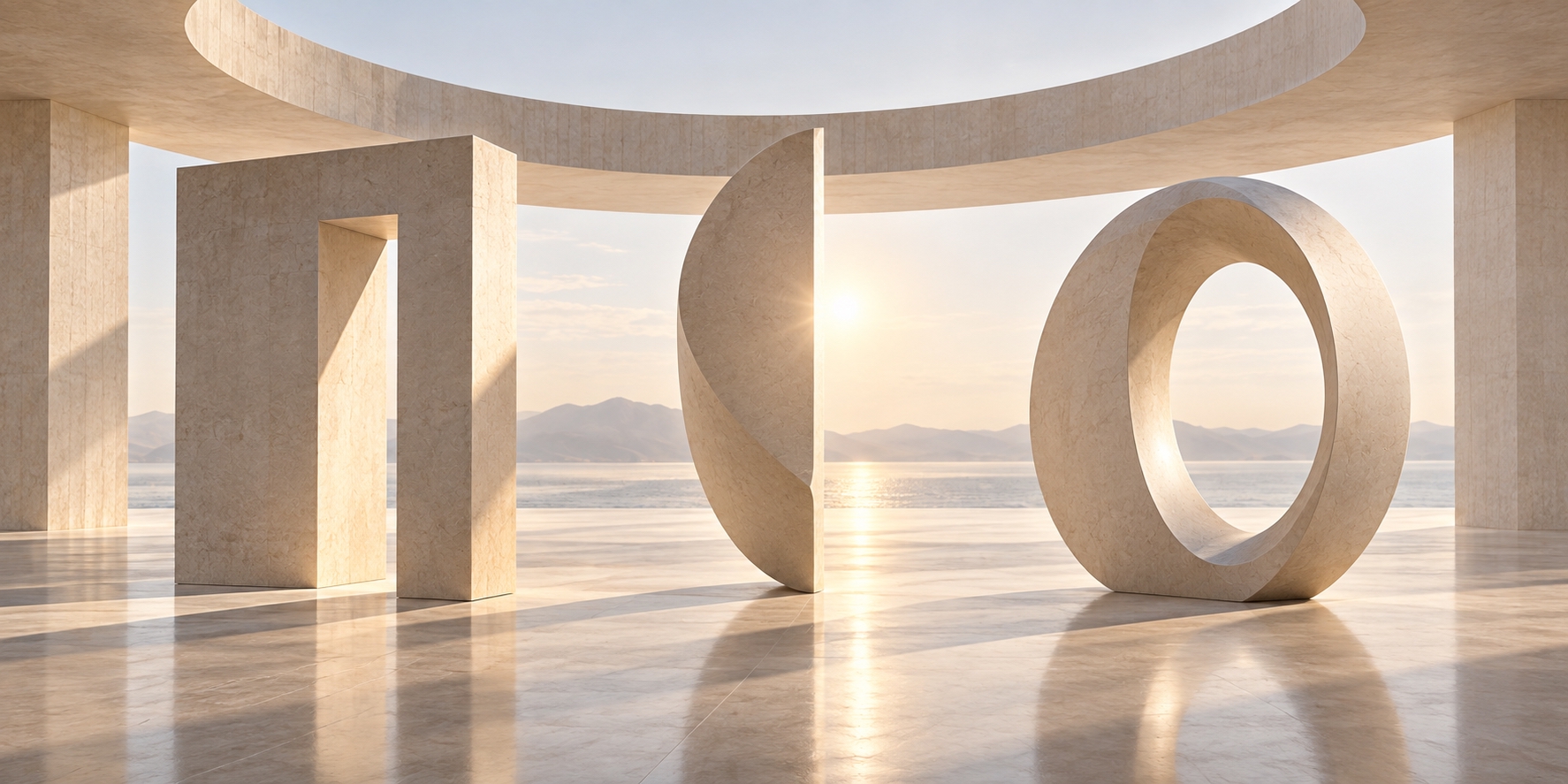
The CASE is the space for thought. It consists of three autonomous MOVES connected by a shared conceptual principle. Each MOVE remains independent. Their relationships open further dimensions of the CASE.
One MOVE can stand on its own. Two MOVES can enter into a relationship. All three open the complete CASE. The CASE prescribes neither a specific interpretation nor a predetermined path of thought.
CONFIGURATION
The spatial arrangement of the MOVES is not fixed. This allows different configurations to emerge. What changes is not the artworks themselves, but the relationships that can be perceived between them.
Two MOVES can form a direct relationship. Three MOVES open multiple relationships simultaneously. Distance, sequence and spatial position can therefore alter the experience of the CASE without compromising the autonomy of any individual MOVE.
RECONFIGURATION
Thought does not move exclusively forward. A later experience can reactivate an earlier thought. Something already seen can be weighted, connected or understood differently through new information.
The physical artwork remains unchanged. What can change is its position within the viewer’s experience.
This is how reconfiguration emerges: not as a change in the artwork, but as a possible change in the mental configuration that has already formed.
LIGHT
In some MOVES, light extends the architecture by adding another perceptual state. What becomes visible in darkness is not a second version of the artwork. It is additional information within the same work.
Visibility, emphasis and relationships can therefore shift. A thought that began by day can continue in another state.
Light does not become an explanation. It becomes information.
THE VIEWER
At the centre of Architecture of Thought™ is the viewer. Universe II does not prescribe thoughts. It creates conditions in which thought can occur.
The viewer completes what is missing, connects what is separate, reconstructs relationships, recalls earlier information or hears something that was never physically spoken.
In this process, a decisive moment can emerge: The viewer does not only discover meaning in the artwork. The viewer discovers where their own thoughts have led them.
HUMOR
Humor is part of this architecture. It is not added to the work afterwards and does not function as a decorative punchline. It can emerge from the same cognitive process through which the viewer creates meaning.
The moment of humor often lies in catching oneself: in realizing that something that seemed to be present in the artwork was, at least in part, created within one’s own thinking.
The artwork does not have to tell the joke. The viewer can create it.
ARCHITECTURE OF THOUGHT™
Architecture of Thought™ therefore does not describe a prescribed path through an artwork. It creates a structure within which thoughts can emerge, form relationships, return and reconfigure.
The first thought is not necessarily the last. Universe II holds thought in motion.
The MOVE is the artwork. The CASE is the journey.